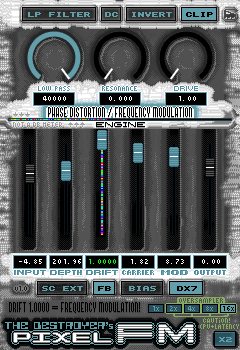
MAIN FEATURES:
- input gain
- depth
- depth
- drift (1.0000 = pure frequency modulation)
- carrier gain
- mod gain
- output gain
- PD/FM modulation meter
- modulation sources: external sidechain (SC EXT)
self feedback (FB)
- bias mode: half-wave rectifier modulation.
- mod gain
- output gain
- PD/FM modulation meter
- modulation sources: external sidechain (SC EXT)
self feedback (FB)
- bias mode: half-wave rectifier modulation.
- DX7 mode
- LP filter with resonance and drive
- DC blocker
- phase invert
- output clip
- built-in oversampler 2x/4x/8x/16x
- x2 zoom
- DC blocker
- phase invert
- output clip
- built-in oversampler 2x/4x/8x/16x
- x2 zoom
THE IDEA BEHIND:
The idea behind
pixelFM
came from my long fascination
with the audio engine of
FM8 by Native Instruments.
Loading it as an effect and pushing
the input into self-feedback,
always produced a raw,
analogue-flavoured distortion
that I found fascinating.
I always wondered what it
would sound like to make two
separate signals collide through FM
distortion but FM8 has no sidechain input
and no dual-entry architecture.
That limitation sparked the idea:
recreate the same algorithm,
but with the ability
to apply this distortion
across any mixer channel
using any other channel
as the modulation source.
The result goes further
than the original inspiration:
thanks to the built-in oversampler,
the high-frequency detail
that FM distortion usually
reduces to noise is preserved,
revealing textures that would
otherwise be lost.
And when Drift reaches 1.0000,
the engine shifts into
pure Frequency Modulation,
the same mathematical heart
that made the Yamaha DX7 a legend.
came from my long fascination
with the audio engine of
FM8 by Native Instruments.
Loading it as an effect and pushing
the input into self-feedback,
always produced a raw,
analogue-flavoured distortion
that I found fascinating.
I always wondered what it
would sound like to make two
separate signals collide through FM
distortion but FM8 has no sidechain input
and no dual-entry architecture.
That limitation sparked the idea:
recreate the same algorithm,
but with the ability
to apply this distortion
across any mixer channel
using any other channel
as the modulation source.
The result goes further
than the original inspiration:
thanks to the built-in oversampler,
the high-frequency detail
that FM distortion usually
reduces to noise is preserved,
revealing textures that would
otherwise be lost.
And when Drift reaches 1.0000,
the engine shifts into
pure Frequency Modulation,
the same mathematical heart
that made the Yamaha DX7 a legend.